
A hit-and-run is one of the most frustrating motorcycle crashes because the driver who caused it disappears—often leaving you injured, stuck with medical bills, and unsure where compensation can come from. In Los Angeles, where traffic is dense and lane changes are constant, hit-and-runs can happen in a split second: a driver merges into your lane, opens a door without looking, makes a sudden left turn, or clips you and keeps going.
If you’re dealing with a hit-and-run motorcycle accident Los Angeles claim, your next 24–72 hours matter. Evidence disappears quickly. Memories fade. Cameras overwrite footage. This guide explains what to do right away, how to preserve proof, and the realistic paths to compensation even if the at-fault driver is never found.
Important: This article is general information, not legal advice for your specific case.
What to Do Immediately After a Hit-and-Run Motorcycle Crash
The priority is always safety, then documentation. Hit-and-run cases are proof-driven: the stronger your evidence, the better your chances of recovering fair compensation through insurance and any identified driver.
Step-by-step actions at the scene
- Move to safety if you can do so without worsening injuries (shoulder/sidewalk, away from traffic).
- Call 911 and request police and medical help. A report matters.
- Get medical attention even if you “feel okay.” Adrenaline masks injuries, especially head/neck trauma.
- Write down what you saw immediately: vehicle color, make/model, partial plate, direction of travel, damage marks.
- Look for witnesses and ask for names/phone numbers. Independent witnesses are powerful in disputed claims.
For a broader checklist, see What to Do Immediately After a Motorcycle Accident.
Evidence you should collect before it disappears
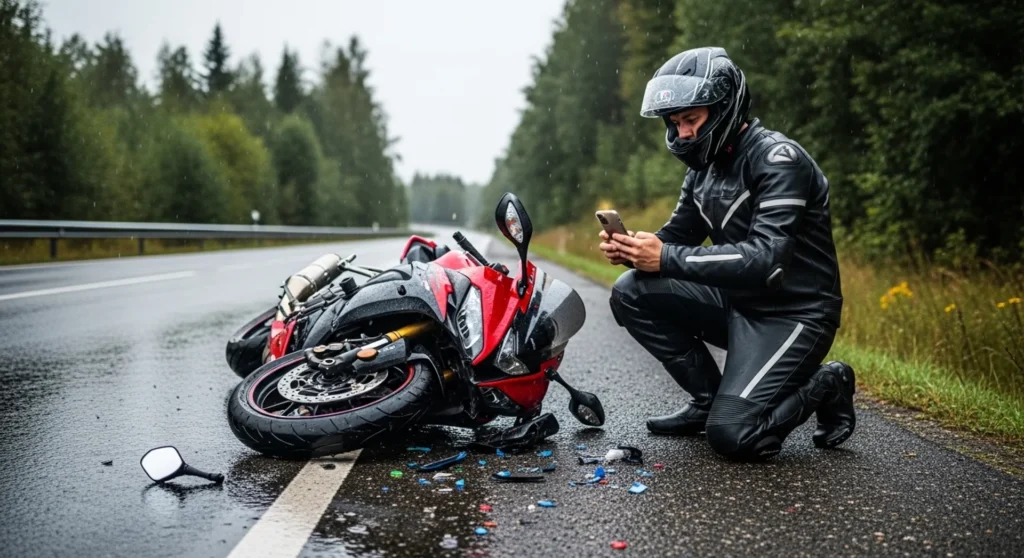
Even if you’re injured, try to capture what you can—or ask someone you trust to do it:
- Photos/video of your motorcycle, your injuries, skid marks, debris, and road conditions
- Photos of nearby intersections, signals, and street signs
- Nearby business names and cameras (gas stations, stores, apartments)
- Dashcam or helmet cam footage (yours or witnesses)
Why the police report matters (even if the driver is gone)
In hit-and-run cases, the police report can become the foundation of your claim. It documents time, location, your statement, witness names, and initial observations. Insurance companies may use the report to evaluate credibility and confirm that the crash was reported promptly.
Be honest and specific. If you don’t know something, say so. Don’t guess. Small inconsistencies can be used later to challenge your version of events.
How Compensation Works When the At-Fault Driver Flees
When the driver is not identified, many injured riders assume they have “no case.” That’s not always true. Depending on your coverage and the facts, there may be multiple financial recovery options.
Option 1: Uninsured Motorist (UM) coverage and hit-and-run claims
In California, uninsured motorist coverage can be critical for hit-and-run crashes because the at-fault driver is effectively “uninsured” from your perspective. If you carry UM (and sometimes UIM), it may pay for medical expenses, lost wages, and other damages—subject to your policy limits and requirements.
A reliable official overview of auto insurance coverages (including UM/UIM concepts) is provided by the California Department of Insurance: https://www.insurance.ca.gov/01-consumers/105-type/95-guides/01-auto/auto101.cfm.
UM claim success often depends on proof
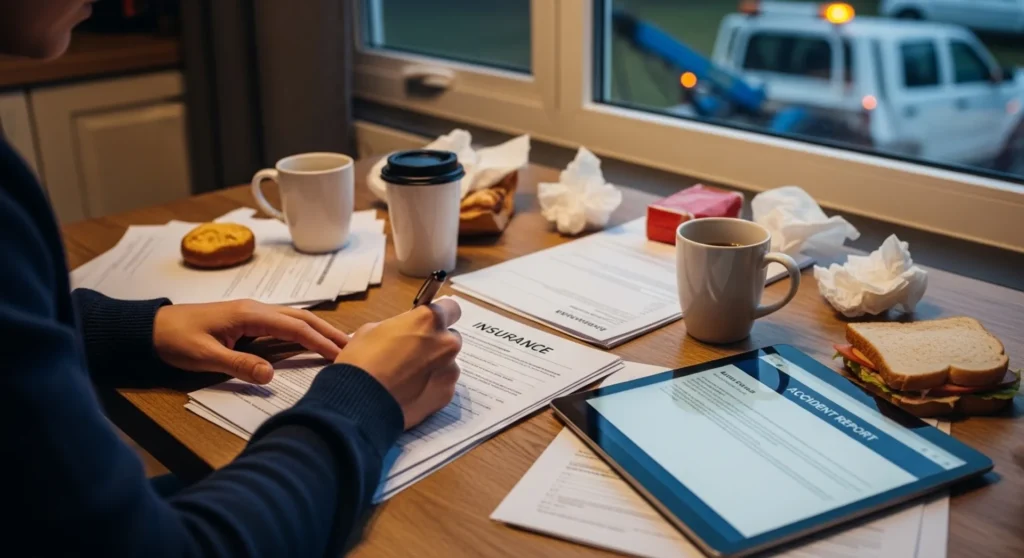
UM carriers may still challenge fault and causation. That’s why evidence and witness statements matter. If you have a “phantom vehicle” situation (a driver causes you to crash without physical contact), the proof burden can be even higher. Video, a witness, or prompt reporting can be the difference between approval and denial.
If you’re trying to understand value and damages, see How Much Is My Motorcycle Accident Claim Worth in Los Angeles?.
Option 2: Collision coverage and MedPay (if you have them)
Even if fault is disputed, your own coverages may help keep you financially stable while the investigation continues:
- Collision: may help repair or replace your motorcycle (minus deductible).
- Medical Payments (MedPay): may cover certain medical costs regardless of fault (policy-dependent).
- Health insurance: often covers treatment, but may seek reimbursement later depending on rules and settlement outcome.
These options don’t replace a liability recovery, but they can prevent financial freefall during treatment.
Option 3: Identifying the driver later through investigation
Not every hit-and-run stays unsolved. Drivers sometimes leave behind evidence: paint transfer, broken mirror parts, or a plate fragment. Businesses may have exterior cameras. Neighborhoods may have doorbell cameras. Your attorney can help request footage quickly before systems overwrite it.
In Los Angeles, speed matters. Many systems automatically delete video after days—not months.
Common Insurance Tactics in Hit-and-Run Motorcycle Cases
Even when coverage exists, insurers often try to reduce payouts. Expect questions like “Were you lane splitting?” “Were you speeding?” “Did you have protective gear?” “Why didn’t you get a plate number?” None of these automatically defeat a claim—but they often show up because the carrier is looking for leverage.
Comparative fault: partial blame can reduce (not erase) recovery
California uses comparative fault rules, meaning compensation can be reduced by your percentage of fault. That’s why insurers focus on rider behavior. A strong claim shows what the driver did wrong and why your actions were reasonable under the circumstances.
Learn how fault arguments work in Understanding California’s Comparative Fault in Motorcycle Accident Cases.
Lane splitting: legal doesn’t mean “no arguments”
Lane splitting is allowed in California, but insurers may still argue it increased risk or that you were traveling too fast for conditions. If lane splitting is part of your crash story, documentation becomes even more important: traffic density, your approximate speed, and the driver’s unsafe lane change.
Internal links (recommended): Lane Splitting in California: Legal Guidelines and Safety Tips and California Lane Splitting Laws Explained.
When to Talk to a Los Angeles Motorcycle Accident Attorney
Hit-and-run cases are high-stakes because you’re often fighting on two fronts: tracking down the driver and pushing your own insurer to pay fairly. A good attorney can help preserve evidence, coordinate records, deal with adjusters, and build the strongest possible liability picture even when the other side is missing.
Signs you should get legal help quickly
- You have fractures, surgery, head injury symptoms, or long-term pain
- The insurer is delaying, denying, or blaming you
- There’s camera footage to preserve (time-sensitive)
- You’re missing work or your bike is totaled
- You’re unsure which coverages apply (UM, collision, MedPay, health)
How to prepare for a consultation (fast and effective)
Bring what you have—even if it’s incomplete:
- Police report number, photos, witness contacts
- Medical discharge papers and bills
- Your insurance declarations page
- A timeline of symptoms and missed work
To understand how representation fits into the process, see The Role of an Attorney in Motorcycle Accident Cases.
Bottom line: If you were hurt in a hit-and-run motorcycle accident Los Angeles scenario, you still may have compensation options. The key is acting quickly, protecting evidence, and building a clear, consistent record of what happened and how it affected your life.