Many motorcycle crashes in Los Angeles happen for one frustrating reason: a driver says, “I didn’t see you.” That excuse shows up in left-turn collisions, sudden pull-outs, and intersection crashes where visibility is already limited by parked cars, big SUVs, delivery vans, and confusing curb zones.
That’s why the California daylighting law motorcycle accident conversation matters right now. California’s “Daylighting” law (AB 413) changed where people can park near crosswalks to improve sightlines at intersections. It took effect on January 1, 2025, and cities continue rolling out education, curb painting, and enforcement. Better visibility can mean fewer crashes—but it also changes how fault and evidence get analyzed after a collision.
What Is the Daylighting Law (AB 413) in California?
AB 413 is a statewide safety rule that prohibits parking (and in many cases stopping/standing) within a set distance of crosswalks so drivers can see pedestrians, cyclists, and other road users earlier. The key point is visibility: clearing the approach to a crosswalk reduces the “parked-car blind spot” that makes intersection conflicts more likely.
- As of January 1, 2025, it is illegal to park within 20 feet of the approach side of a crosswalk (marked or unmarked). Some areas and designs have different measurements (like curb extensions/bulb-outs). Always check local signage and curb markings.
City transportation departments explain the purpose clearly: improving visibility near intersections and crosswalks to prevent collisions. (AB 413 is commonly described as “daylighting.”)
External authority resources:
City of Pasadena – Daylighting Law (AB 413) overview
and
SFMTA – Daylighting explanation.
How AB 413 Connects to Los Angeles Motorcycle Crash Cases
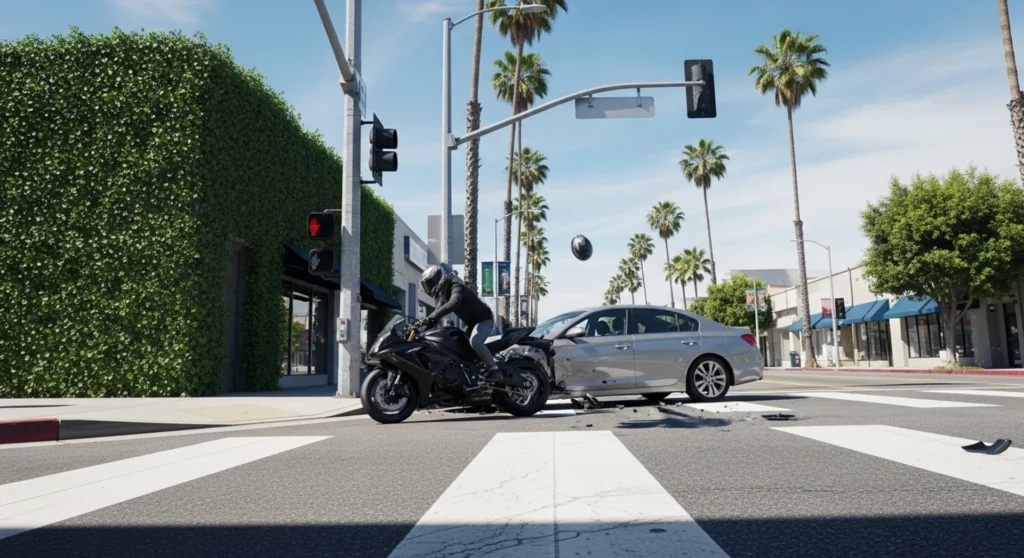
Even though AB 413 is framed around pedestrian safety, it’s relevant to motorcyclists because the same blocked sightlines that hide a pedestrian can also hide a rider. In Los Angeles traffic, a single parked van near a corner can block a driver’s view of an approaching motorcycle for critical seconds.
Here’s where the California daylighting law motorcycle accident angle becomes practical:
- Left-turn crashes: A driver turns left across your path at an intersection. If a parked vehicle blocked the driver’s view, AB 413 may help explain why visibility was compromised and whether someone created a dangerous condition.
- Pull-out crashes: A driver exits a driveway or side street and “doesn’t see” the rider until it’s too late.
- Crosswalk-adjacent conflicts: Congested curb lanes plus poor sightlines create sudden braking, swerving, or impact scenarios.
Importantly, AB 413 doesn’t automatically “prove” who is at fault. But it can affect how investigators, insurance adjusters, and attorneys evaluate whether someone acted reasonably—or created a predictable hazard.
Liability: Who Can Be Responsible When Visibility Is Blocked?
1) The Turning or Merging Driver
Most intersection motorcycle crashes still come back to driver negligence: unsafe left turns, failure to yield, distracted driving, or misjudging speed and distance. Even if visibility is imperfect, drivers have a duty to proceed safely, creep forward carefully, and not “commit” into a turn if they can’t confirm it’s clear.
If you want a broader overview of why representation matters after a crash, this internal guide fits well:
Why Hire Auto Accident Lawyers After a Car or Motorcycle Crash?
2) The Parked Vehicle Owner (in limited situations)
Most of the time, a parked vehicle is just “there.” But if the vehicle is parked illegally in a restricted daylighting zone and it materially contributed to a dangerous blind spot, it can become part of the fact pattern. Whether that translates into legal liability depends on the details, local enforcement, and how directly the illegal parking contributed to the collision.
3) A City or Agency (complex, deadline-sensitive)
If the roadway design, signage, curb painting, or construction zone created an unreasonable safety hazard, a public entity can sometimes be involved. Claims against government entities can have special notice requirements and shorter deadlines, so the timing and documentation are critical.
4) Comparative Fault (when insurers try to pin it on the rider)
Insurance companies often look for ways to shift blame to the motorcyclist: “too fast for conditions,” “should have anticipated,” or “lane position.” Don’t be surprised if they argue you should have slowed even more at an intersection with reduced visibility. This is exactly why evidence is everything.
Evidence That Wins a Daylighting-Related Motorcycle Accident Claim
Because AB 413 is about sightlines, your goal is to prove what a driver could (and couldn’t) see at the moment decisions were made. Strong evidence includes:
1) Scene photos that show sightlines (not just damage)
- Take wide shots from the driver’s perspective (where they were stopped/turning).
- Capture the parked car/van/truck that blocked the view and its distance to the crosswalk.
- Photograph the crosswalk area (marked or unmarked), curb paint, signs, and corner geometry.
2) Video footage (the fastest-disappearing evidence)
Look for nearby business cameras, traffic cameras, and residential doorbell cameras. Time matters—many systems overwrite footage quickly. A preservation request can be crucial.
3) Witness statements
Witnesses can confirm whether a vehicle was parked too close to a crosswalk, whether the driver “shot the gap,” and whether the rider was traveling normally.
4) Police report + diagram details
If the report includes vehicle positions, the point of impact, and lane markings, it can support how visibility played into decision-making.
5) Your medical records (don’t delay)
Intersection crashes often cause fractures, shoulder injuries, head injuries, and spinal issues. Treatment gaps are one of the first things insurers attack.
Also link internally to a related value/compensation topic for readers:
How Much Is My Motorcycle Accident Claim Worth in Los Angeles?
What To Do Right After an Intersection Motorcycle Crash in LA
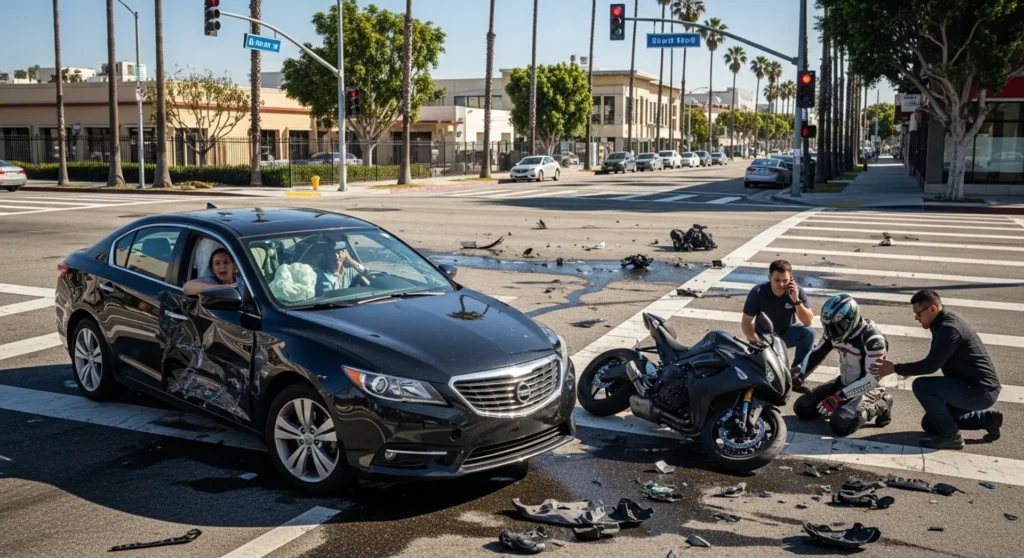
- Get medical help first. If there’s any head impact, neck pain, or severe pain, treat it as urgent.
- Call the police and request a report. Even if the driver tries to “handle it privately.”
- Photograph sightlines immediately. If the illegally parked vehicle leaves, that visual proof can be gone forever.
- Get witness info. Names + phone numbers. A short voice memo (with permission) can help preserve details.
- Don’t give a recorded statement on the spot. Provide basic facts, but don’t let an insurer lock you into wording before you know your injuries.
How Lane Splitting Fits Into This Conversation (Because It Will Come Up)
In Los Angeles, lane splitting is common. If your crash occurred while lane splitting, the defense may try to use it as a blame lever—even though it is legal in California. The California Highway Patrol provides public guidance noting lane splitting is legal and highlights unsafe driver behaviors like intentionally impeding a rider or opening a door to interfere.
External authority resource:
California Highway Patrol – California Motorcyclist Safety (Lane Splitting)
If you want to keep readers on-site, this internal article is a natural next step:
California Lane Splitting Laws Explained: What Every Rider Needs to Know
Real-World Example: The “Parked Van Blind Spot” Left-Turn Crash
Here’s a common fact pattern in LA:
- A large van is parked close to the corner near a crosswalk.
- A driver stops at the intersection, but the van blocks the driver’s view of oncoming traffic for a moment.
- The driver inches forward and turns left.
- A motorcycle appears from behind the blind spot—impact happens in the intersection.
In a scenario like this, AB 413 becomes relevant because it focuses on preventing exactly that kind of corner blind spot. The investigation may ask: Was the van parked illegally close to the crosswalk? Was the driver turning safely given the limited visibility? Did the rider have time or space to avoid impact? Those answers are evidence-driven, not opinion-driven.
Bottom Line: AB 413 Won’t “Hand You a Case”—But It Can Strengthen the Story
When a motorcycle crash happens at an intersection, the winning cases are the ones built on clear visuals and timelines: who could see what, when, and what choices were made. The California daylighting law motorcycle accident angle matters because it centers the case on visibility and safety—not stereotypes about riders.
If you were hurt in a Los Angeles motorcycle crash, document the sightlines immediately, preserve video fast, and get medical care. Then evaluate the legal options with the full evidence in hand.
Related internal read (especially if the at-fault driver fled):
Hit-and-Run Motorcycle Accidents in Los Angeles: What to Do and How to Get Compensation