
Los Angeles speed cameras are becoming a new part of the city’s traffic-safety system in 2026. For motorcycle riders, the program matters for more than avoiding a speeding citation.
Automated speed data may also become relevant after certain motorcycle crashes, especially when drivers and riders disagree about speed, timing, visibility, or how quickly a collision developed.
The Los Angeles Department of Transportation is rolling out 125 speed safety systems around the city. The cameras are being placed on selected high-risk corridors, including locations near schools, senior centers, and streets with histories of speeding or serious crashes.
However, a speed-camera record should not be confused with a complete motorcycle accident investigation.
A civil camera citation does not automatically prove negligence. It also does not establish that speeding caused a particular collision. Motorcycle claims still require evidence about vehicle movement, right of way, visibility, road conditions, injuries, and the actions of everyone involved.
How Los Angeles Speed Cameras Work in 2026
Los Angeles is implementing the program under California’s automated speed enforcement pilot authorized by Assembly Bill 645.
LADOT says the systems use automated technology to identify vehicles traveling significantly faster than the posted speed limit. The program is designed to discourage excessive speeding on streets where speed-related crashes create serious risks.
Unlike a traditional traffic stop, the system does not require an officer to observe the violation from a patrol vehicle.
The Cameras Begin Enforcement at 11 MPH Over the Speed Limit
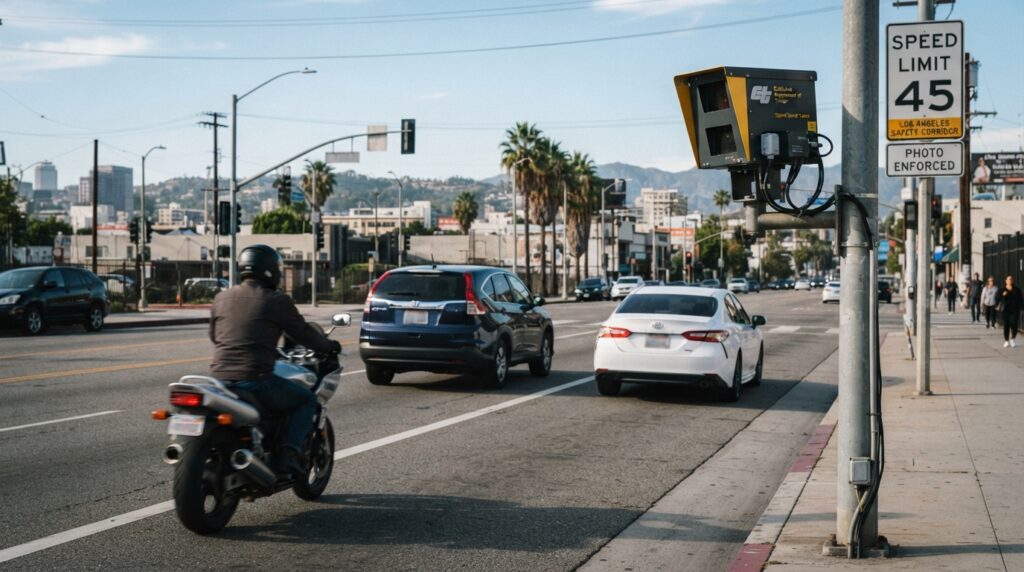
LADOT says its systems identify vehicles traveling at least 11 miles per hour above the posted limit.
During the first 60 days after a camera location becomes active, qualifying vehicles receive warning notices rather than fines.
After that warning period ends, civil penalties begin.
The first level is $50 for traveling 11 to 15 mph above the posted limit. Higher speeds carry larger penalties under the program.
A motorcycle can fall within that system just like another registered vehicle if its rear license plate is visible to the equipment.
Speed-Camera Citations Are Civil and Do Not Add License Points
The new program should not be confused with a traditional speeding ticket issued by a police officer.
LADOT describes the automated violations as civil penalties. They do not create driver’s-license points through the normal DMV point system.
That distinction matters after a motorcycle accident.
A camera notice may document that a registered vehicle exceeded the enforcement threshold at a specific camera location, but the existence of a civil citation does not automatically establish civil liability for a later crash.
For example, a driver might receive a camera citation several blocks before a collision. Investigators would still need to determine the vehicle’s speed and conduct when the actual crash occurred.
Likewise, if a motorcycle triggered a camera before being struck by a left-turning vehicle, an insurer may point to the record when arguing comparative fault. The rider may respond with other evidence about the driver’s turn, sight distance, traffic signals, braking, and where the collision occurred.
The site’s guide to left-turn motorcycle accident claims in Los Angeles explains why speed is only one part of that type of investigation.
Speed-Camera Data Has Privacy and Retention Limits
Los Angeles designed the program with restrictions on the information collected.
LADOT says the cameras capture rear license-plate information needed for enforcement rather than broad facial-recognition or driver-identification data.
The city’s use policy also establishes different retention periods depending on whether the camera information results in a violation.
Photographic or related information that does not result in a notice can be retained only for a short period. Evidence associated with an actual notice may remain longer while the citation is processed or challenged.
That timing can matter after a serious motorcycle crash.
If someone believes camera information could be relevant, waiting months before investigating may create problems because some records may already have been deleted under the program’s retention rules.
Whether particular records can be obtained for a private civil case depends on applicable law and legal procedure. Riders should not assume that all camera footage or data is automatically available to accident victims.
Speed Evidence Can Matter When Fault Is Disputed
Motorcycle crashes often create disputes about speed.
A driver may say the motorcycle appeared suddenly. The rider may say the driver turned directly into the lane. An insurer may argue that the rider was traveling too fast to avoid the impact.
Those arguments are especially common in intersection crashes.
Accurate speed evidence can help investigators evaluate those competing versions of events.
Camera Data Should Be Compared With Other Crash Evidence
No responsible investigation should rely on one data source when several are available.
A nearby speed-camera record could be compared with dashcam or helmet-camera video, vehicle event data, surveillance footage, witness statements, physical damage, skid evidence, traffic-signal timing, and police observations.
Each source answers a different question.
A helmet camera may show when another vehicle began turning. Vehicle data may show braking. Witnesses may describe traffic movement. Roadway measurements can help establish distance.
Medical records then document a different part of the case: the injuries caused by the collision and how those injuries affected the rider.
This is why riders should preserve their own digital evidence even as Los Angeles expands automated enforcement.
If a motorcycle has a dashcam or helmet camera, save the original file as soon as possible. Do not rely only on a shortened social-media upload because metadata and portions of the recording may be lost.
What Speed Cameras Could Mean for Motorcycle Accident Claims
The new camera system may create useful evidence in some cases, but its importance will depend heavily on where the crash occurred and what the camera actually recorded.
A collision happening directly within a monitored corridor may create stronger questions about camera data than a crash several miles away.
Timing also matters.
A vehicle’s speed before a collision can provide context, but investigators still need evidence showing what happened at the point of impact.
Comparative Fault Can Make Speed Evidence Important
California follows a comparative fault system.
That means more than one person can share responsibility for a collision, and compensation may be reduced according to the injured person’s assigned percentage of fault.
This issue frequently appears in motorcycle cases because insurers may argue that rider speed contributed to the crash even when another driver made an unsafe turn or lane change.
A speed-camera record could become part of that debate.
However, exceeding the speed limit does not automatically erase another driver’s negligence. Investigators still need to consider whether the other driver yielded, checked mirrors, obeyed traffic signals, maintained a proper lookout, and had enough time to see the motorcycle.
A Speed Citation Does Not Automatically Decide Negligence
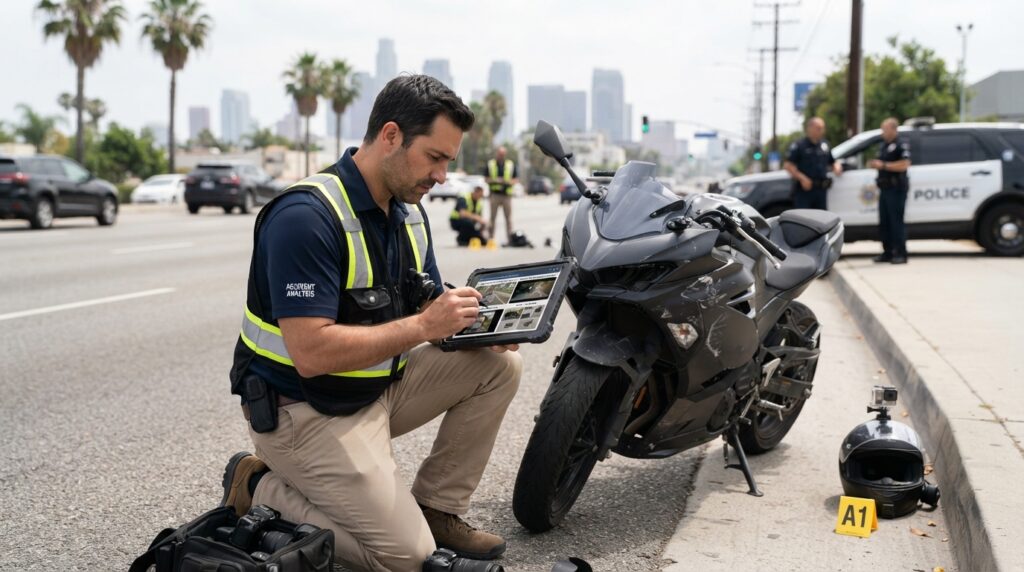
A civil citation and a civil injury claim answer different questions.
The automated system asks whether a registered vehicle crossed the program’s speed threshold at a monitored location.
A motorcycle accident claim asks whether someone’s conduct legally caused or contributed to the collision and resulting injuries.
Those questions can overlap, but they are not identical.
Suppose a rider passed a camera at 12 mph over the limit, then slowed before reaching an intersection. A later camera citation would not necessarily establish the motorcycle’s speed at impact.
In another case, the timing and location of the camera could place the speed measurement much closer to the collision. That evidence may carry more significance.
Context is therefore essential.
Riders involved in a crash should also preserve scene photographs, witness names, police information, damaged riding gear, medical records, repair estimates, and insurance communications.
The site’s step-by-step guide after a California motorcycle accident provides a broader evidence checklist.
The new cameras also make existing rider video more valuable as a comparison source.
If a helmet camera shows traffic movement immediately before impact, that recording may help explain speed-camera information rather than leaving an insurer to interpret a number without context.
Los Angeles chose the 125 camera locations because officials identified speeding and serious traffic safety problems on selected corridors.
LADOT reported that about one in five fatal Los Angeles crashes in 2024 was directly attributed to speeding. The department’s broader 2026 program documents also describe speed as a major factor in crash severity.
For motorcyclists, that matters because riders have much less physical protection when a high-speed collision occurs.
The new system may reduce dangerous speeding over time. It may also produce another category of digital information that becomes relevant when crash responsibility is disputed.
Still, riders and drivers should avoid treating Los Angeles speed cameras as automatic accident witnesses.
The cameras are primarily enforcement tools. They record limited information for a specific purpose and operate under privacy and retention rules.
A serious motorcycle accident investigation remains broader.
It may involve motorcycle video, traffic cameras, vehicle electronics, witnesses, scene measurements, police reports, maintenance records, medical evidence, and expert analysis.
When a nearby speed safety system exists, its records may become one additional piece of that puzzle.
For current camera locations, warning periods, fines, and official program rules, riders can review the Los Angeles Department of Transportation Speed Safety System page.
This article provides general educational information and is not legal advice. Speed-camera rules, evidence availability, comparative negligence, insurance issues, and filing deadlines depend on the facts of each case and applicable law.